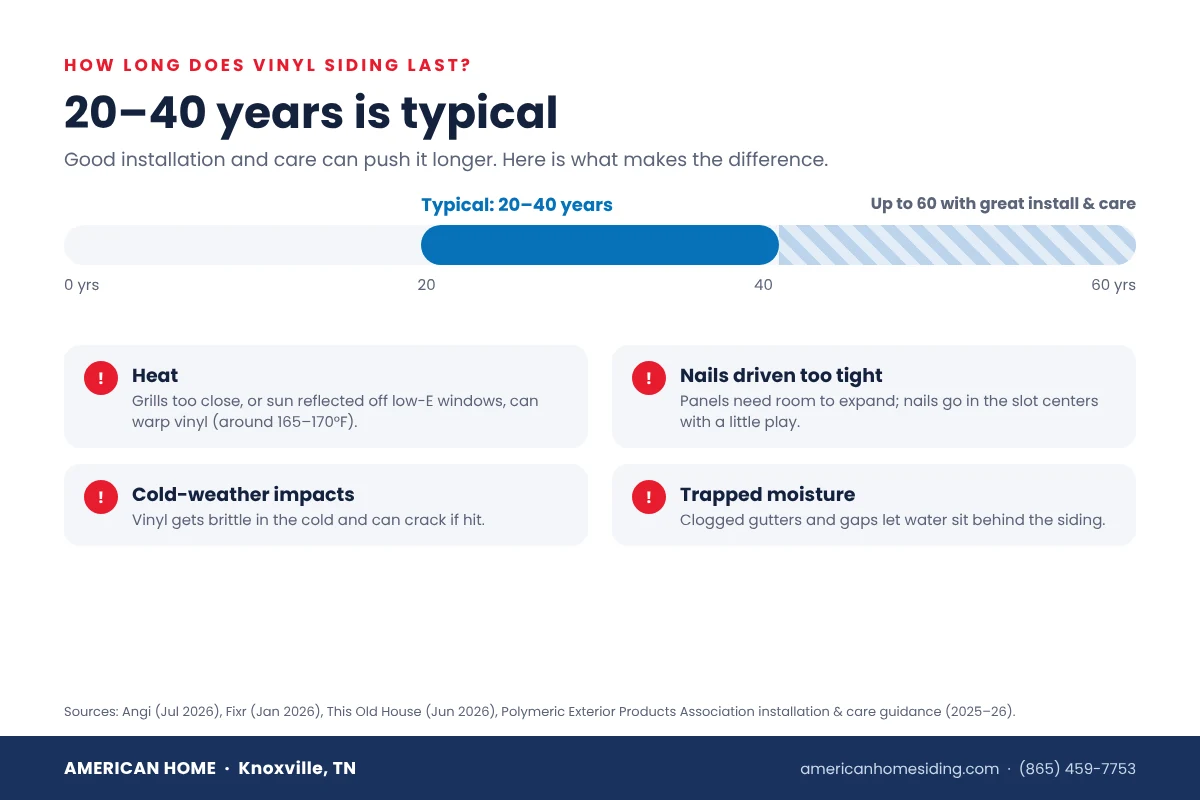
If you are thinking about new siding, or wondering whether your current siding is near the end, one question comes first: how long does vinyl siding last? The short answer is 20 to 40 years for most homes. The longer answer depends on how it was installed, how thick it is and how much sun, heat and moisture it faces. Here is what the research says, what shortens vinyl siding lifespan, and how to make yours last.
In this article
How long does vinyl siding last?
- Angi (July 2026): 20 to 40 years, and as little as 20 years in some cases.
- Fixr (January 2026): 20 to 40 years on average, often 30 to 40, and closer to 20 in extreme climates.
- This Old House (June 2026): up to 60 years with proper installation and maintenance.
So a realistic range for an East Tennessee home is 20 to 40 years, with well-installed, well-kept, thicker vinyl reaching the top of that range or beyond.
What shortens vinyl siding lifespan
1. Heat
The Polymeric Exterior Products Association (PEPA), the vinyl siding trade group, warns that vinyl can melt or warp near significant heat and recommends keeping grills a safe distance away. Sunlight reflected off a neighbor’s low-E windows can also distort vinyl. Angi puts vinyl’s melting point at around 165°F, and reflected light can push surface temperatures higher.
2. Installation mistakes
Vinyl expands and contracts with temperature. PEPA’s installation guidance says nails should be centered in the slots with about 1/32 inch of clearance under the nail head, roughly the thickness of a dime. Nailing too tight makes panels buckle and pull loose, which lets water in.
3. Cold-weather impacts
Vinyl gets more brittle in the cold and can crack if it is hit. Hail, flying debris and even a basketball can do it. Our hail damage siding guide shows what to look for after a storm.
4. Trapped moisture
Clogged gutters, missing flashing and gaps at windows let water sit behind the siding. The vinyl itself won’t rot, but the sheathing behind it can.
5. Thin panels and fading
Thicker vinyl is stiffer and stands up better. Fixr lists builder-grade vinyl at about .040 inch and premium vinyl at .046 inch or more. Our Alside Odyssey Plus vinyl is a heavy-duty .044-inch nominal panel. Darker colors and cheaper panels can also fade unevenly in strong sun.
Signs your vinyl siding is wearing out
- Cracks, holes or missing pieces
- Warped, wavy or sagging panels
- Uneven or heavy fading
- Mold, mildew or a musty smell near walls
- Peeling paint or stains on interior walls
- Rising energy bills or drafty rooms
For the full checklist, read when to replace siding: 7 warning signs.
How to make vinyl siding last longer
- Rinse it with a garden hose once or twice a year. For dirt, PEPA recommends mild soap and water with a soft brush, working from the bottom up.
- For mildew, PEPA suggests a mix of about 30% vinegar and 70% water.
- Avoid harsh solvents, undiluted bleach and grease removers.
- If you pressure wash, keep the spray at eye level and never aim it upward under the laps. Some manufacturers advise against it.
- Keep grills and other heat sources well away from the walls.
- Clean gutters and fix damaged pieces quickly so water does not get behind the siding.
Vinyl siding warranties
Quality vinyl comes with long warranties. Alside’s vinyl siding warranty, for example, is a lifetime limited warranty for the original owner that transfers once as a 50-year prorated warranty. Warranties do not cover installation mistakes, which is another reason to choose an experienced installer.
Comparing materials? See vinyl vs fiber cement siding or our insulated vinyl siding guide.
The short answer: how long does vinyl siding last on an East Tennessee home? Usually 20 to 40 years, depending on panel quality, color, sun exposure and how well it was installed. If you are asking yourself “how long does vinyl siding last on my house?”, a quick inspection will tell you more than the age alone.
Not sure how much life your siding has left? Call (865) 459-7753 or request a free in-home estimate. We will check your walls and tell you honestly whether repair or replacement makes more sense.
Vinyl siding lifespan FAQ
Does vinyl siding last 50 years?
It can, but 20 to 40 years is more typical. This Old House says up to 60 years is possible with proper installation and care.
Does vinyl siding fade?
Some fading over decades is normal. Better panels use fade-resistant color technology, and warranties like Alside’s cover fading beyond a set limit.
Is it time to replace 30-year-old vinyl siding?
Not automatically. If it is still flat, solid and watertight, it may have years left. Cracks, warping or water damage are the signs to act on.
How long does vinyl siding last before it fades?
It depends on the panel quality, the color and how much sun the wall gets. Darker colors and budget panels tend to fade sooner, while premium panels with stronger color protection hold their color longer. Check what the manufacturer’s warranty says about fading.
How long does vinyl siding last compared with fiber cement?
Quality vinyl often lasts 20 to 40 years. Fiber cement such as James Hardie carries a 30-year non-prorated limited warranty on the siding and can last even longer with good upkeep. See our vinyl vs fiber cement siding comparison.